

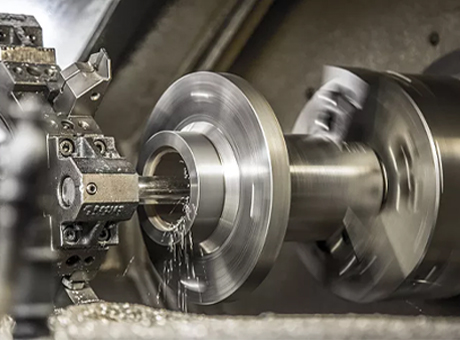
1. The workpiece is overcut in the CNC lathe processing.
1. Bounce knife, the compressive strength of the CNC blade is insufficient or too long, causing the CNC knife to bounce. In this case, it is necessary to understand the standard of CNC lathe processing tools: it can be large or small, and it can be short or long.
2. The operator's actual operation is poor. In this case, the top milling application must be added, and the machining allowance should be distributed as evenly as possible (the side and bottom machining allowances should be the same).
3. The turning allowance is uneven. (For example, leave 0.5 for the side of the bevel and 0.15 for the bottom). In this case, it is necessary to scientifically and reasonably adjust the basic parameters of turning, and to round the corners with large machining allowance.
4. The main parameters of turning are wrong (such as: large dimensional tolerance, SF setting is too fast, etc.). At this time, it is necessary to make full use of the SF function of the CNC lathe, and the operator can adjust the speed to improve the actual effect of the CNC lathe turning.
2. The causes and solutions of the phenomenon in the machining process of CNC lathes.
There are four basic reasons for the phenomenon of splitting:
1. The operator's manual operation is not accurate.
2. There are burrs near the plastic mold.
3. The centring rod is magnetic.
4. The four corners of the abrasive tool are not vertical.
You can improve it according to the following solutions:
1. The manual operation should be done carefully and carefully, and the points should be at the same point and the same height as much as possible.
2. Use a whetstone or a file knife to grind and polish around the abrasive tool, then wipe it with a waste cloth, and finally determine it by hand.
3. Demagnetize the centring rod before centring the abrasive tool, (can use porcelain centring stick or others).
4. Check whether the four corners of the grinding tool are vertical by the calibration table (the deviation of the horizontality needs to be checked with the milling worker for the implementation plan).
3. Many friends have reported that there will be tool setting problems during the machining process of CNC lathes. What is the cause and how to solve it?
We must first analyze the main reasons for the knife setting problem:
1. The operator's manual operation is inaccurate.
2. The CNC tool turning is incorrect.
3. The cutter head on the flying knife is incorrect (the flying knife itself has a certain deviation).
4. There is a deviation between the R knife and the flat bottom knife and the flying knife.
Knowing the cause of the problem, we can prescribe the right medicine and solve the tool setting problem in the CNC lathe processing process one by one:
1. The manual operation should be carefully checked repeatedly, and the knife setting should be at the same point as much as possible.
2. When turning CNC tools, it should be cleaned with a hot air gun or wiped with rags.
3. The cutting head on the flying knife needs to measure the boring cutter, and one head can be used when the bottom edge is smooth.
4. An independent tool setting program flow can avoid the deviation between the R knife and the flat knife and the flying knife.